The HVAC industry has gone through a lot of changes over the last three years. The 2026 landscape is about finalizing the AIM Act and a total transition to next-generation refrigerants.
For both homeowners and contractors, 2026 is the year when the transition period finally ends. The new standards of high-efficiency cooling are just starting. In this article, I’m going to discuss the changes coming to the HVAC industry in 2026.
| TL;DR In 2026, the HVAC industry has officially transitioned from a grace period to a strict new reality defined by mandated A2L refrigerants, high-efficiency SEER2 compliance, and AI-driven predictive maintenance. |
The Evolution of HVAC Standards between 2023 and 2026
The industry changes have been the talk of the town for some time already. Department of Energy (DOE) and the EPA did some phasing out at the start of 2023.
- On January 1, 2023, M1 Testing Standards started. The SEER2 rating replaced traditional SEER, EER2 replaced EER, and HSPF2 replaced HSPF.
- January 1, 2026, was the hard deadline. All new residential installations today must meet the updated GWP (Global Warming Potential) limit of 700.
The New HVAC Industry Standards in 2026
The standards in 2026 have the general theme of implementing past regulations. This shift is the final stage of the EPA’s phasedown under the AIM Act, which mandates a transition to refrigerants with a Global Warming Potential (GWP) of less than 700.

1. Refrigerant Shifts
New systems are switching from R-410A to R-454B or R-32 (A2L refrigerants).
In 2025, the rules focused more on manufacturing the refrigerant. Factories had to stop making the old R-410A units. Contractors could still sell or install whatever they had in their warehouse throughout 2025.
As of January 1, 2026, that “grace period” for many systems has ended. If a contractor installs a new system, it must be one of the lower-impact refrigerant models.
Brands Adapting to Refrigerant Changes
Manufacturers have different approaches to meet the AIM Act requirements of refrigerants.
- Carrier primarily uses R-32. It’s a single-component refrigerant with a GWP of 675.
- Trane mainly uses R-454B (Opteon XL41). Its GWP is even lower (466).
Brands also have different HVAC coils to handle the pressures of different A2L refrigerants.
2. New Installations Must be SEER2 Compliant
The same thing goes for SEER2 regulations. From 2023 to 2025, the industry also had its grace period of lower-SEER units. In 2026, the non-compliant SEER2 inventory is basically dead. Federal and local enforcement have focused on the implementation.
The SEER2 rating is roughly 4.5% more stringent than the old SEER metric because it uses the M1 testing standard. It factors in the higher external static pressure in real conditions like your home’s ductwork.
Southern region homes must install 14.3 SEER2 units, and Northern homes must install 13.4 SEER2 units for all new central HVAC systems.
3. Pricey HVAC Services
Refrigerant availability and finding older parts are now labor and time-intensive.
No one is coming to rip out your old 2015 AC unit. However, nobody is manufacturing the parts and refrigerant either. When you have to recharge an old system, it’s going to cost you (or your HVAC service provider) more to find them.
The same goes for the parts. As some models are getting unavailable, manufacturers are less focused on parts of the systems. Replacements of those parts are getting pricier due to the unavailability.
For many homeowners, this extra price creates a new tipping point for an upgrade. We have already been noticing the shift in mindsets among users in all of our service areas.
The Quickest Way to Keep Up with the New Standards
Maintenance is the most efficient way you can keep up under new standards.
Both repairs and refrigerant recharging have become costlier. The most effective way is not to run into those situations. HVAC maintenance is the best solution for that.
Neglecting maintenance means you lower the efficiency of an already inefficient unit. You can still use it. However, you are bound to run into repairs or leaks sooner (and quicker replacement because of shorter lifespan).
Routine maintenance helps you keep up with efficiency. Even though you may not meet the SEER2 requirement with your old unit, you can get as much out of it as possible. You also run into repairs less and save on parts’ hassle.
For compliant systems, regular maintenance helps you keep the peak performance.
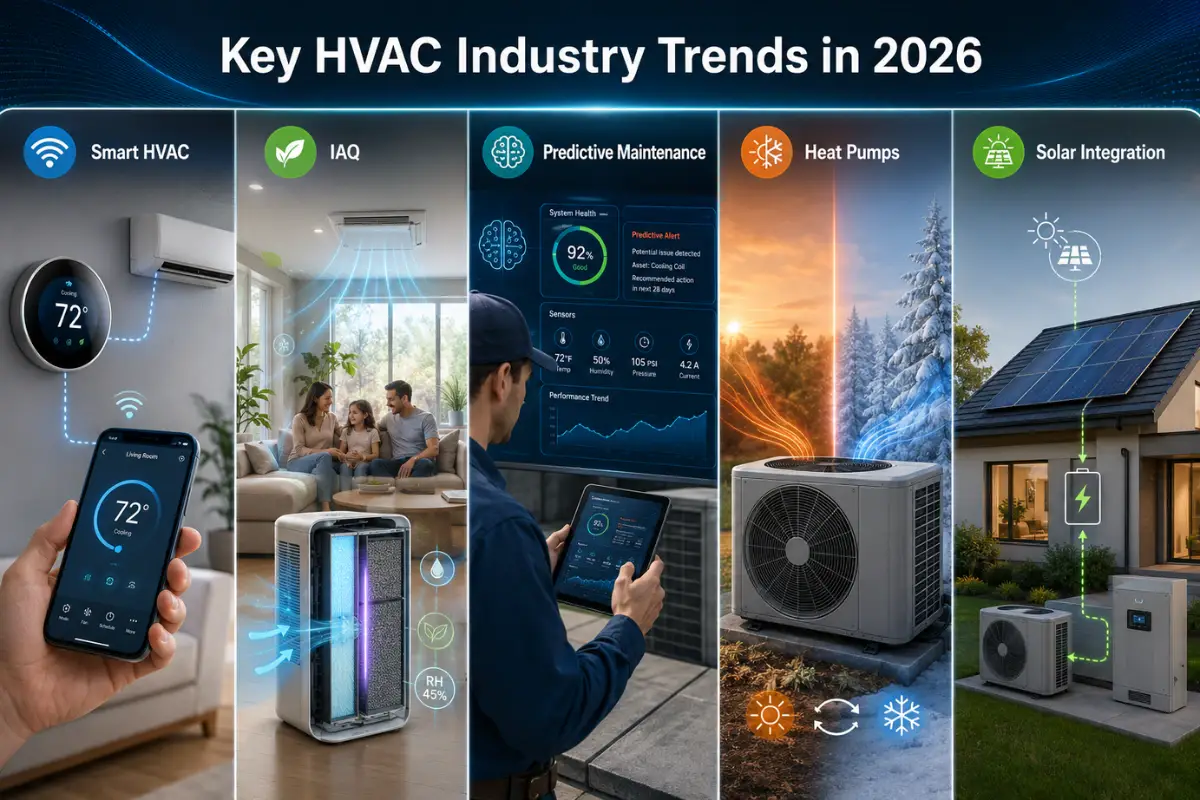
Key HVAC Industry Trends in 2026
Beyond regulations, different technologies in the industry are redefining home comfort. We are seeing technologies that were once reserved for hospital-grade systems.
1. Rise of Smart HVAC Systems
Smart HVAC technological innovation is primarily making the way for fulfilling sustainability goals.
Smart thermostats have been here for some time. Now, it is getting truly “connected”. It can connect with indoor coil and outdoor compressors, and the sensors can alert you to issues based on shared data.
You can now connect advanced HVAC systems with full smart home networks. Homeowners can monitor and control AC settings through voice commands, mobile apps, and even AI.
2. More Focus on IAQ
Comfort has shifted from temperature control to a home health system.
- Most new systems now use MERV 13 or HEPA filters as a baseline.
- UV-C light installation has continued to climb post-COVID curve.
- HVAC systems now feature more humidity control.
3. Predictive Maintenance and Remote Diagnostics
Top brands are using IoT sensors to feed data into Agentic AI platforms. Then it performs a remote diagnostic process that helps technicians arrive with the right parts the first time.
If your AC broke in 2025, you had to call a technician. In 2026, the top brands have already launched “Agentic AI” platforms. It can predict the issues beforehand and has already been reducing unplanned downtime by about 45%.
The new refrigerants we mentioned before are still mildly flammable. IoT sensors can help you prevent any disaster.
Another upside is the low electricity bills. Predictive AI doesn’t let the system go into any struggling state. With efficient parts, the systems continue to perform efficiently as well.
4. Shifts Towards Sustainable Systems
48% of the US homes have shifted to electrical heating systems, and 60% of them even pay a premium for eco-friendly systems.
Electrification has already been one of the biggest movements in the HVAC industry. Incentives for using electrical systems are growing. HEEHRA rebates and 25C tax credits can make up to $2,000 for high-efficiency heat pump installations. The technologies in the heat pump are also advancing.
So, many households are already moving away from fossil fuel-based systems. Besides, modern heat pumps can now provide efficient heating in colder climates.
The transition to heat pumps and electrification supports the renewable energy goals and lowers the carbon footprint.
5. Renewable Energy Integration
HVAC systems are getting more connected with solar energy solutions.
More homeowners are investing in solar panels. New HVAC system designs have that specific utility in mind. The idea is to depend less on the power grid and use sunlight as the primary source driving HVAC systems.
As a result, the homes are getting more self-sustaining.
HVAC Marketing Trends for 2026
Most of the regulatory focus is on residential units. The shift in commercial HVAC services is equally intense for transitioning and scaling into the sustainability trends.
For business owners, the word-of-mouth era has already ended for some time now. The all-time high competition has moved online. Precision-targeted marketing has become more necessary than ever.
- The average cost per lead in 2026 is $70-$150 in the HVAC industry.
- High-competition markets can reach $250 per lead.
- Successful HVAC owners reinvest 8-12% of the revenue back into marketing.
- Google Business Profiles and ‘local intent’ HVAC SEO have become the primary driver of new customers
Key HVAC Industry Statistics in 2026
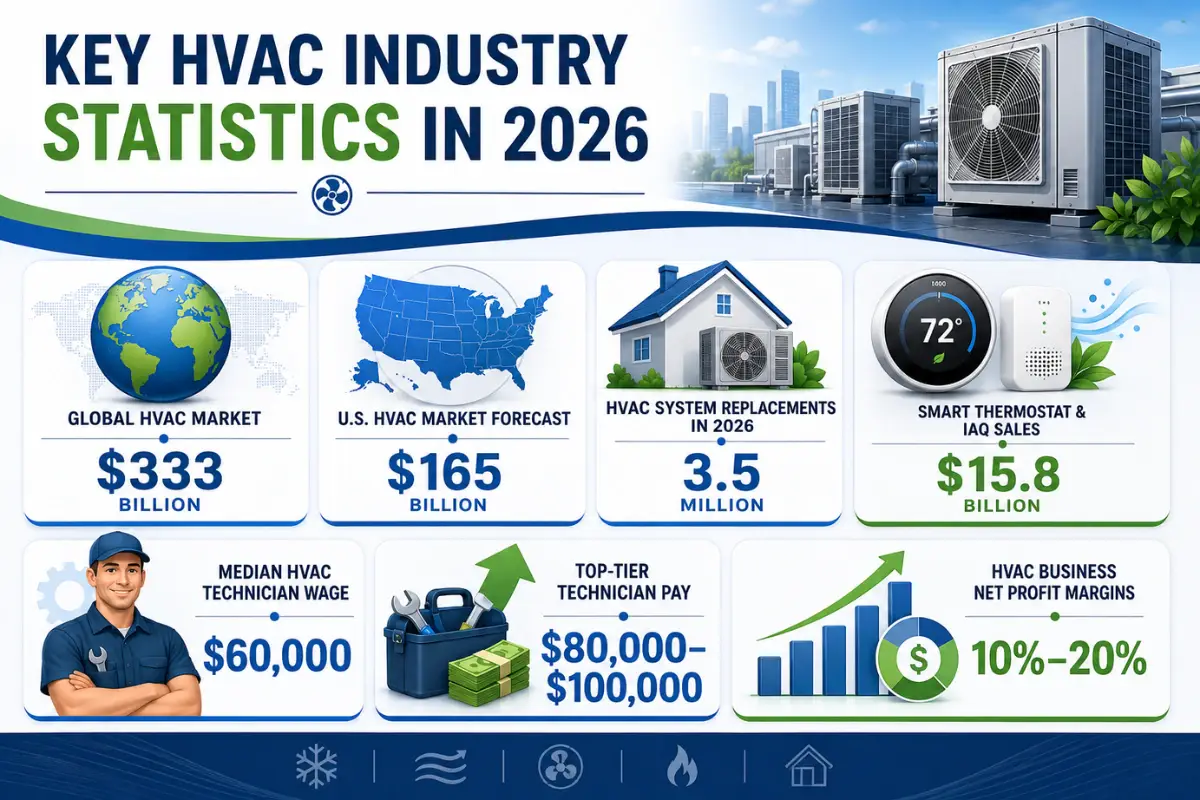
Let’s look at the number to feel the scale of these changes.
- The global HVAC market value is $333 billion.
- Among them, the US market forecast has a value of $165 billion.
- In 2026, the number of HVAC system replacements can reach 3.5 million.
- Smart thermostat and IAQ sales are projected to rise $15.8 billion
- The median annual wage for an HVAC technician was $60,000 in 2026.
- Top-tier technicians earn between $80,000 and $1,00,000 in high-demand areas.
- With a strategic financial plan, HVAC businesses can have 10 to 20% stable net profit margins.
Frequently Asked Questions About HVAC Standards
What were the HVAC changes in 2023?
The HVAC industry saw the SEER2 metric changes in 2023. Homeowners had to satisfy higher efficiency minimums: 13.4 SEER2 in the North and 14.3 SEER2 in the South.
Can I still buy R-410A in 2026?
Yes. In fact, if your current unit uses R-410A, you might have to buy it anyway (unless you made modifications). However, the production is now strictly limited and restricted in some cases. So the availability is very low, and the price would be very high.
What is the new refrigerant mandate?
The EPA refrigerant mandate is to use refrigerants that have a GWP lower than 700 in residential systems. A2L refrigerants like R-454B or R-32 meet that requirement.
Will the new A2L refrigerants affect my home insurance or warranty?
Your current insurance policy won’t change because of the mandate. However, many manufacturers have updated their limited warranties for 2026. New A2L systems also require installations from A2L-certified technicians.
Can I refill the new refrigerants into my old R-410A system?
No. Different refrigerants have different pressures and specific safety sensors. New A2L ones don’t match those with the old R-410A units.
Do the 2026 standards require ductwork changes?
In most cases, no. The new M1 testing standards assume a higher external static pressure. If your ductwork is leaky, undersized, or underperforming in general, your new SEER2 unit will struggle. Then again, it’s not regulation-specific. Your ductwork would have been unsuitable either way.
Conclusion
The HVAC industry is past the era of cooling your room. It is now a sophisticated sector with environmental responsibility, high-tech integration, and proactive care. Whether you are a homeowner who wants to save energy or a business owner who wants to scale, stay ahead of SEER2 and refrigerant shifts to get the most out of the HVAC industry in 2026.