Earlier, heating and cooling meant a furnace and an air conditioner. Now, the HVAC systems are connected and intelligent. With the advances of AI, IoT, energy-efficient equipment, and smart home technology, modern HVAC systems can now learn your habits and do all sorts of stuff to optimize energy usage.
I see my clients and manufacturers both rethinking how heating and cooling systems operate on a daily basis. Understanding the modern innovations helps you make smarter long-term decisions. The future of HVAC is focused on creating healthier, more efficient, and more connected homes.
What Makes an HVAC System “Smart”?
Smart HVAC systems have intelligent controls, connected devices, and automated decision-making capabilities. These systems collect information from sensors throughout your home. Instead of operating on a fixed schedule, these systems adjust their output based on the real-world data it collected.
How Smart HVAC Systems Work
The “connected devices” in most HVAC systems are:
- Smart thermostats
- Temperature and humidity sensors
- Occupancy or motion sensors
- Variable-speed heating and cooling equipment
- Wi-Fi connectivity
- Mobile applications
- Cloud-based monitoring and analytics
These systems constantly evaluate data like indoor temperature, humidity, outdoor weather, occupancy, and historical usage patterns. They determine what’s the best output on their own. You get a comfortable home that doesn’t waste unnecessary energy.
More Than Remote Control
Many people tell me they want a smart HVAC system just to “control the temperature from their phone”. However, the technology goes beyond that. Modern systems can:
- Learn your daily schedule automatically
- Detect when rooms are occupied
- Adjust settings based on weather forecasts
- Send maintenance reminders
- Track energy consumption
- Monitor indoor air quality
- Alert homeowners when performance begins to decline
Smart Thermostats: The Brain Behind Modern HVAC
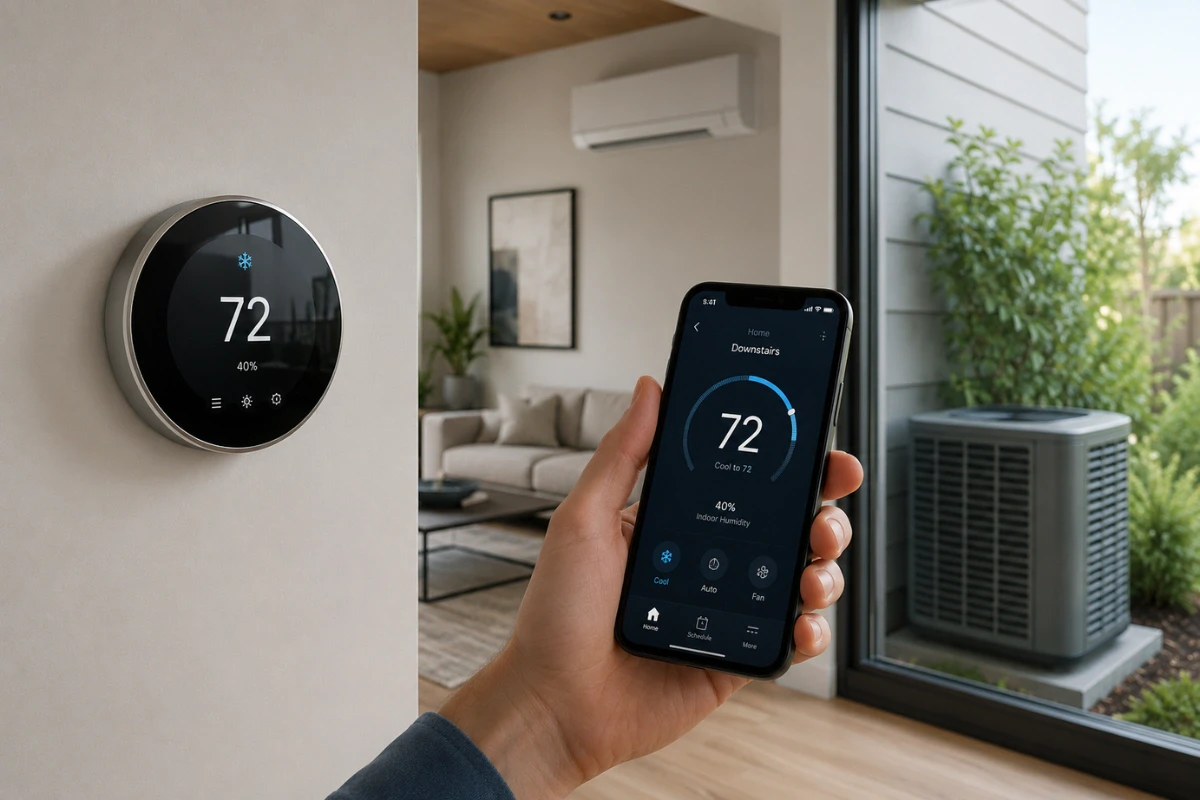
The smart thermostat has become the centerpiece of today’s smart HVAC systems. Programmable thermostats introduced scheduled temperature changes years ago. Now, smart thermostats take the automation much further:
Learning Your Daily Habits
Instead of asking you to manually program weekday and weekend schedules, many smart thermostats gradually learn:
- When everyone leaves for work
- When the family returns home
- Typical sleeping hours
- Preferred daytime temperatures
- Seasonal comfort preferences
The longer the system operates, the better it understands your household.
AI Makes Smarter Decisions
Artificial intelligence adds another layer of intelligence. Instead of simply following a schedule, AI evaluates multiple factors simultaneously, including:
- Outdoor temperatures
- Indoor humidity
- Occupancy
- Historical runtime
- Local weather forecasts
- Equipment performance
For example, let’s say tomorrow’s weather forecast predicts a cooler evening. The system will delay cooling during the afternoon because it knows the outdoor temperatures will naturally help the home cool down. You avoid the need to constantly readjust or unnecessary runtime on your system.
Occupancy Detection and Geofencing
Modern systems also pay attention to when someone is in the home. Some systems use motion sensors, occupancy sensors, and smartphone location services. When there are no people in the room, the thermostat can turn off or switch to energy-saving mode.
Remote Control Anywhere
It’s one of the most popular and well-known features. You can change temperatures, turn the system on/off, switch modes, and receive alerts directly on your smartphone or computer. Regardless of where you are, your system always stays within your reach.
Voice Control and Smart Home Compatibility
You can integrate your smart thermostat with other smart home features:
- Smart lighting
- Automated blinds
- Security systems
- Smart speakers
- Home automation routines
Everything works together as one connected home.
Understanding Energy Usage
Many smart thermostats show you a detailed report of energy usage. You can get:
- Daily energy consumption
- Monthly trends
- Runtime history
- Peak usage periods
- Estimated savings
You can see exactly how your HVAC system performs throughout the year. Some systems even recommend adjustments that could reduce your energy consumption further without sacrificing comfort.
IoT Is Changing the Way HVAC Systems Think
IoT stands for Internet of Things. It allows HVAC systems to become a connected system on a broader network.

Real-Time Health and Comfort Tracking
As we’ve already mentioned, modern systems use distributed sensors to continuously monitor conditions like temperature, humidity, airflow, occupancy, and filter life. Your system always gets a complete picture of a home’s environment rather than relying on a single thermostat.
Cloud Diagnostics
With your permission, many modern systems send performance information securely to cloud-based platforms. If you share the information with your technicians, they can diagnose the issues before arriving.
Whole-Home Efficiency
Connected devices collaborate to save energy. When smart blinds automatically close to block afternoon sun, the home stays cooler naturally. Your thermostat can then delay the cooling cycles to lower electricity bills.
Prevent Problems Before They Happen with Predictive Maintenance
For decades, HVAC maintenance has been reactive. A strange noise appears, your AC stops cooling, or your furnace doesn’t start. Only then did you have to call for service. Modern HVAC technology is changing that approach.
Smart HVAC systems continuously analyze operating conditions to identify early warning signs. They check every parameter, such as:
- Compressor performance
- Fan motor speed
- Airflow restrictions
- Temperature differences
- Electrical consumption
- Refrigerant behavior
- Vibration levels
Using AI and machine learning, modern HVAC systems compare the current performance with the expected performance. If it detects any problem, it’ll give you automatic maintenance alerts, which also help your technician to work smarter. Very early detection of the issues also means you get a long equipment lifespan with fresher parts.
Variable-Speed Technology is a Smarter Way to Heat and Cool Your Home
Yes, the “new” system works differently, but the main reason behind outperforming the old systems is that modern systems operate more efficiently. Traditional systems had to be either on or off. Variable-speed compressors, as the name suggests, can operate at different speeds to adjust the output.
How Variable-Speed Systems Work
Rather than operating at 100% capacity all the time, a variable-speed system can gradually increase or decrease its performance throughout the day. For example:
- A mild morning may require only 30% capacity.
- A hot afternoon might require 75%.
- During extreme weather, the system can operate near full output.
Benefits of Variable-Speed Technology
Variable-speed systems maintain a much narrower range of operation. That comes with:
- Fewer temperature swings
- More even airflow
- Better humidity control
- Reduced hot and cold spots
- Improved comfort throughout the day
- Quieter operation
- Less wear on equipment
Smart Zoning Systems Offer Personalized Comfort
Traditional HVAC systems treat the entire house as a single unit. The problem is that not every room in the house needs the same heating or cooling. You waste a bunch of energy in the process. Smart zoning solves the issue with multiple controllable areas, which is particularly helpful for installing HVAC in commercial spaces and large properties.
What Is HVAC Zoning?
In zoning, your central ductwork is separated into multiple zones. Technicians do that by using dampers and multiple thermostats or sensors. The HVAC system directs the airflow only where you need it. If you equip a smart thermostat for each zone, you can get the benefits of automation for every zone.
Why Zoning Improves Efficiency
Heating or cooling an empty room wastes energy. With HVAC zoning, you get directed air conditioning only where occupants need it. You reduce unnecessary runtime. This approach is especially helpful for multi-story homes or large floor plans with many rooms.
Indoor Air Quality Is Becoming a Core HVAC Feature
People are spending the majority of their time indoors. That’s why indoor air quality has become one of the fastest-growing areas in HVAC innovations. Today’s systems can monitor, clean, and improve the air people breathe every day.

The Monitoring System
Smart sensors monitor indoor air quality in real time. Traditional systems used to move air throughout the home, but they offered little info on what’s actually in it. Modern systems can continuously monitor:
- Dust levels
- Allergens
- Humidity
- Airborne particles
- Ventilation performance
- Volatile organic compounds (VOCs)
- Carbon dioxide levels
You don’t have to wait to notice stale or uncomfortable air. The HVAC system can respond to the metrics automatically.
How Smart Systems Adjust Air Quality
As mentioned, sensors first detect the problem. Depending on your equipment, the system then either increases ventilation, filtration or adjusts humidification and purification cycles. Throughout the process, there’s minimal manual adjustment involved.
Filtration Systems at Play
Media filters have improved significantly to become highly efficient. With the introduction of HEPA, filters can offer multi-stage and electrostatic purification. You can also install UV-C lights directly inside the ductwork that kill biological contaminants in the air before recirculating.
A Shift Towards Heat Pumps for a Sustainable Future
We used to treat heat pumps as mild-climate equipment. Now, heat pumps can maintain their high efficiency across a wide variety of temperatures. With energy efficiency being the priority in today’s world, heat pumps’ popularity is rising as expected.
Unlike AC and gas furnaces, heat pumps can offer both cooling and heating in the same unit. Instead of generating heat, they operate by transferring heat from indoors to outdoors and vice versa. Even in harsh, cold climates, heat pumps are capable of removing heat from the inside to make it warmer. That’s why heat pumps have been one of the highest projections in the HVAC revenue forecast.
Why Heat Pumps Continue Growing in Popularity
Heat pumps offer:
- High energy efficiency
- Lower operating costs
- Quiet performance
- Heating and cooling in one system
- Reduced fossil fuel dependence
- Excellent compatibility with smart controls
These benefits are some charming additions to the worldwide movement of moving away from carbon emissions.
Dual-Fuel Systems Offer Extra Flexibility
The AC and heat pump trend shows an increased popularity in very cold climates. A dual-fuel system is basically a heat pump paired with a furnace. The heat pump can operate most of the time efficiently and keep the operating costs and carbon emissions low. When it’s completely out of hand, the gas furnace can kick in and provide the necessary cooling.
Eco-Friendly Refrigerants Are Reshaping the HVAC Industry

Speaking of carbon emissions, the refrigerant shift is advancing with the goal of reducing ozone emissions even further. The refrigerant regulations have already been one of the most important changes in the HVAC industry. Manufacturers are now focusing more on systems that lower environmental impact.
Older refrigerants have already started to be phased out. Modern HVAC systems are increasingly using next-gen refrigerants that have almost zero ozone layer depletion potential without sacrificing efficiency.
Influence of Renewable Energy
Sustainability is another global movement every industry is participating in. Manufacturers are integrating renewable energy sources into heating and cooling systems to lower utility bills and reduce environmental impact. Next-gen HVAC systems are now using solar power, geothermal energy, battery storage, and advanced energy management software.
Solar HVAC Systems
Solar HVAC systems use photovoltaic (PV) panels to generate electricity. That electricity powers heating and cooling equipment. Depending on the system, the solar energy may:
- Power the air conditioner/heat pump directly
- Offset household HVAC energy consumption
- Charge the battery storage for later use
Geothermal HVAC
Geothermal HVAC systems use the Earth’s natural temperature. Outdoor temperature can fluctuate, but the temperature below the surface remains almost the same. Geothermal exchange with this heat through underground loops.
However, the installation costs of geothermal systems are very high compared to conventional systems. They are more like a long-term investment with high energy savings and durability.
The Next Generation of Sustainable Cooling
Researchers continue to explore new approaches to cooling. Some emerging technologies are:
- Thermal energy storage
- Waste heat recovery
- Thermally driven air conditioning
These technologies focus on making better use of renewable energy and existing heat sources. They are still in the early stages of development, but they show where the industry is shifting.
Connected Living Environment with Smart Home Integration
HVAC is no longer an isolated system. Modern homes have smart lighting, locks, voice assistants, etc. Today’s HVAC equipment can become a part of this system. Voice control makes everyday operation even easier.
The automation goes beyond temperature control. You get a more personalized home that adapts to your routine.
AI and Energy Analytics in HVAC
HVAC brand trends indicate that almost all manufacturers are focusing on investing in AI. It’s not surprising when you consider all the added benefits.
With the collected data from sensors, artificial intelligence and cloud-based analytics can give you predictive reports. Based on the report, you can make adjustments to improve your energy usage and comfort (or let the system handle it for you).
Some systems provide:
- Daily energy reports
- Monthly performance summaries
- Peak demand analysis
- Personalized efficiency recommendations
- Utility cost estimates
The smart adjustments also help reduce the reliance on the energy grid. A smart system with AI can pre-cool your home before high-demand periods. For most homeowners, these adjustments are barely noticeable. However, the contribution to lower energy costs and improved grid stability is undeniable.
What the Future Holds for Smart HVAC
The pace of HVAC innovation is only picking up. In the future, the HVAC systems are likely to get more autonomous. The interaction needed with homeowners is going to be less, while the performance and efficiency are going to rise.
- AI will continue to learn and make sophisticated decisions.
- IAQ will become just as important as heating and cooling.
- HVAC systems will get more connected to smart appliances and BMS.
- Sustainability will drive more innovation and progress.
Is Upgrading to a Smart HVAC System Worth It?
Upgrading to a smart system is definitely worth it if you are already upgrading. If your equipment is already at the limit of its lifespan, upgrading to a smart HVAC system offers:
- Better comfort
- Lower utility costs
- Improved indoor air quality
- More consistent temperatures
- Remote access
- Predictive maintenance
- Greater environmental sustainability
If you are not ready for an upgrade, you can start with small changes. For example, you can add a smart thermostat or upgrade indoor air quality equipment with an already existing Goodman 3-ton 15.2 SEER2 or Trane 3-ton 16 SEER2 unit.
That’s the effective part of smart HVAC. You don’t have to afford the whole system at once. You can invest over a longer timeframe to make your upgrades easier and more cost-effective.
Conclusion
Smart HVAC innovations are changing how your home is heated and cooled. Artificial intelligence, connected sensors, advanced filtration, renewable energy, and high-efficiency equipment are working together to give you a better environment indoors. Instead of maintaining a set temperature, you can expect fully automated and energy-saving updates without any manual inputs. At the same time, you lower your carbon footprint and save energy to affect the environment in a good way.
Smart HVAC Innovations FAQ
Do smart HVAC systems actually save energy?
Yes. Features like smart thermostats, variable-speed equipment, zoning, occupancy detection, and predictive controls reduce unnecessary runtime. Your HVAC system can also automatically adjust its settings based on the report.
Can I upgrade my existing HVAC system with smart technology?
In many cases, yes. You can often start with a compatible smart thermostat or indoor air quality monitor before upgrading to fully connected HVAC equipment.
Are heat pumps considered smart HVAC technology?
Heat pumps have been here for some time, but modern models are considered smart, with smart controls. You get Wi-Fi connectivity, variable-speed operation, and integration with home automation systems with modern heat pumps.
How does predictive maintenance work?
Smart systems in your HVAC system continuously monitor different parameters in your system. It compares the data with the baseline data. If it detects a problem, it alerts you and recommends action accordingly.
Is smart HVAC only useful for new homes?
No. Many existing homes can use smart thermostats, zoning controls, connected sensors, and other upgrades. You can often use these upgrades with your existing system.