Knowing how to choose an air purifier for your home starts with matching the purifier’s filter type, size, and features to your indoor air quality needs.
Most of us spend about 90% of our time indoors, where air can be two to five times more polluted than outside air. Polluted indoor air can trigger headaches, allergies, restless sleep, and increase long-term heart and lung risks. Tiny particles like PM2.5 are linked to strokes, heart disease, and lung cancer, making a properly chosen purifier essential.
This air purifier buying guide breaks down everything you need to know from filters and sizing to certifications, energy use, and maintenance, so you can confidently select the best purifier for your home and breathe easier every day.
Key Takeaways
|
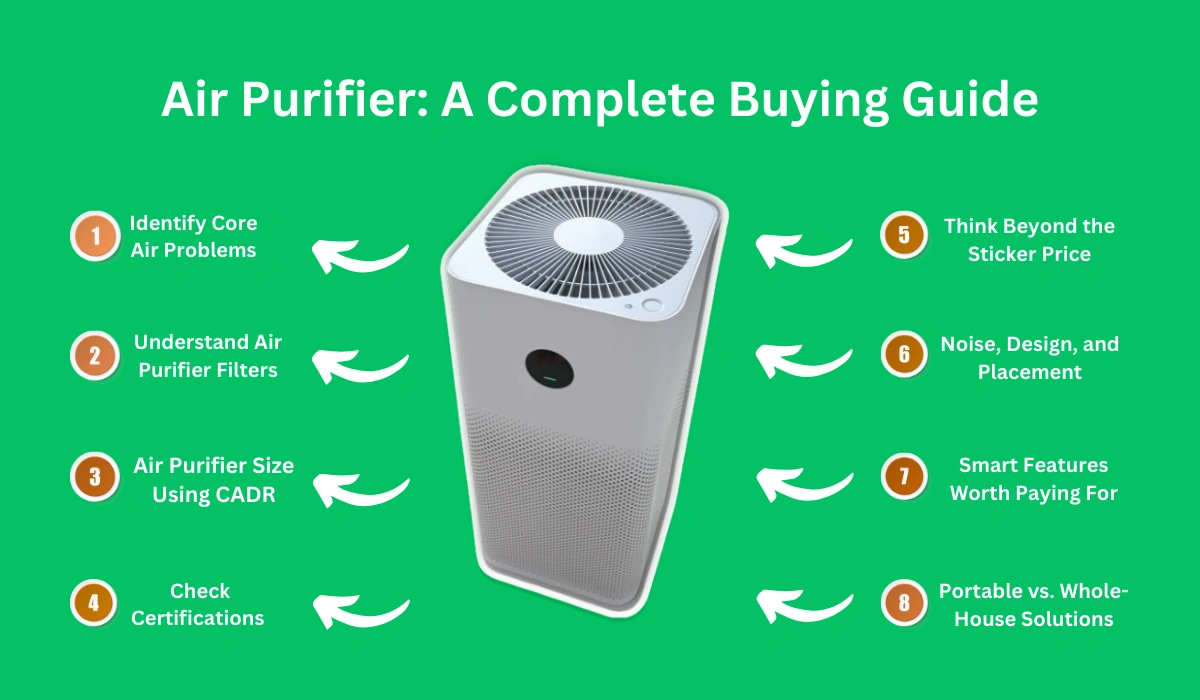
Step 1: Identify Your Biggest Air Problems
Before you start comparing models, knowing how to choose an air purifier begins by understanding the specific air quality challenges in your home.
Every purifier excels at different types of pollutants, dust, allergens, smoke, odors, or chemicals, and selecting the right one depends on the problems you face daily. Taking a little time to observe your home can save money, time, and frustration.
| Problem / Pollutant | Questions to Ask Yourself |
| Dust and Allergens | – Do surfaces get dusty quickly, even after cleaning?
– Do family members wake up congested, sneeze frequently, or experience allergy symptoms? |
| Wildfire or City Smoke | – Does seasonal smoke or pollution drift into your rooms?
– Can you sometimes smell smoke even when windows are closed? |
| Pets and Everyday Odors | – Does pet hair collect on furniture and floors faster than expected?
– Do cooking smells, litter boxes, or musty odors linger longer than desired? |
| Chemicals & Volatile Organic Compounds (VOCs) | – Have you recently painted, remodeled, or installed new furniture, carpets, or flooring?
– Do you frequently use strong cleaning products, air fresheners, or hobby chemicals that release fumes? |
By answering these questions, you gain clarity on what to look for in an air purifier, the filters required, and the type of system that will truly improve your indoor air quality. Understanding your household’s main concerns ensures your purchase meets your health and comfort needs.
Step 2: Understand Air Purifier Filters
Filters are the heart of any air purifier. Knowing what to check before buying an air purifier guarantees that the system you select removes harmful pollutants effectively. Filters vary in design and purpose, so understanding their roles is crucial.
| Filter Type | What It Removes | What to Look For |
| True HEPA | Dust, pollen, mold spores, smoke, fine diesel soot | Look for True HEPA (H13/H14) with 99.97% capture of 0.3 µm particles. Avoid vague terms like “HEPA-type” or “95% HEPA.” |
| Activated Carbon | Odors, VOCs, gases | Thicker carbon beds last longer and absorb more pollutants than thin sprayed layers. |
| Pre-filter | Hair, lint, pet fur | Washable mesh filters trap larger debris, extend the main filter life, and reduce replacement costs. |
Optional Technologies:
Ionizers, Plasma, or PCO: Can help neutralize fumes but may produce trace ozone. Choose CARB-certified units to ensure safety.
UV-C Lamps: Work against live microorganisms only when the lamp is strong and air passes slowly enough.
Electrostatic Plates: Require minimal maintenance but are less effective on fine smoke compared to True HEPA.
For most homes, combining a True HEPA filter with a substantial activated carbon filter offers the most reliable and safe approach for effective air purification.
Step 3: Size Your Air Purifier Using CADR
Even the best filters cannot compensate for weak airflow. Clean Air Delivery Rate (CADR) measures how efficiently a purifier removes smoke, dust, and pollen. According to the U.S. EPA, CADR is “the most helpful parameter for judging portable air cleaners.” Choosing the right CADR ensures your air purifier works effectively in your space.
The ⅔ Rule
To determine the ideal CADR for smoke:
- Example: Room 12 ft × 15 ft = 180 ft² → minimum smoke CADR ≈ 120 CFM
Increase this number if ceilings are taller than 8 ft, if you live in a wildfire-prone region, or if you plan to run the purifier only part-time.
Quick Sizing Checklist
- Measure the length and width of your room.
- Multiply by 2/3 to estimate the minimum smoke CADR.
- Compare with the purifier’s CADR or AHAM-Verified label.
- If the value is too low, consider a larger unit or multiple purifiers.
Following this ensures you know how to choose an air purifier size accurately, maintaining clean air even during pollen-heavy or smoky days.
Step 4: Check Certifications and Labels
Independent certifications confirm that manufacturer’s claims are real and safe. Knowing what to look for when buying an air purifier helps you avoid misleading advertising and ensures consistent performance.
| Certification | Guarantees | Why It Matters |
| AHAM Verifide | CADR tested for smoke, dust, pollen | Confirms real lab-tested performance. |
| ENERGY STAR | Uses ~25% less energy than standard models | Saves electricity and reduces environmental impact. |
| CARB Certified | Ozone ≤ 0.050 ppm | Ensures safe ozone levels indoors. |
| UL/ETL Safety | Passed electrical and fire safety tests | Protects against overheating or electrical hazards. |
Labels like AHAM, ENERGY STAR, and CARB are essential when buying an air purifier to make sure it works safely, efficiently, and as advertised.
Step 5: Think Beyond the Sticker Price
The upfront price of a purifier is only part of the total cost. A complete air purifier buying guide includes long-term costs:
Filter Replacements: True HEPA (6–12 months, $35–$120), Activated Carbon (3–6 months). Pre-filters can extend the main filter life.
Electricity Use: Continuous operation consumes ≈ 450 kWh/year. ENERGY STAR models reduce this by about 25%.
Total Cost of Ownership: Add purchase price, filter replacements, and energy costs over five years. High-efficiency units often save more in the long term due to lower energy use and fewer filter changes.
Considering these factors ensures you choose a unit that is affordable over time, not just at purchase.
Step 6: Noise, Design, and Placement
An air purifier is only effective if it runs consistently. Unfortunately, many devices get turned off simply because they are too noisy or awkward to place. When considering how to choose air purifier for your home, both sound level and physical design are crucial.
Noise Levels:
- ≤ 30 dB: Whisper-quiet, barely noticeable even in a silent bedroom. Perfect for sleeping or working without distraction.
- 30–50 dB: Gentle background hum, similar to a soft conversation or quiet fan. Comfortable for living rooms or kitchens during the day.
- 50+ dB: Sounds like a normal conversation; suitable for short-term operation but may be disruptive if left running continuously.
Pay attention to the noise ratings at the purifier’s highest fan speed, because that’s when it will perform most effectively during high-pollution events, such as wildfire smoke or heavy pollen days.
Design Considerations:
Sleep or Night Mode: Automatically dims lights and slows fans, so you get clean air without disrupting your sleep or quiet activities.
Form Factor: Slim tower designs fit neatly beside furniture or desks, while cube-style purifiers allow larger filters but occupy more floor space.
Vent Orientation: Top vents allow placement closer to walls without restricting airflow, while side vents may require more open space.
Child Safety and Pet Protection: Look for child-lock features and sealed panels to prevent curious little hands or paws from tampering with the device.
Proper noise control and thoughtful design ensure your purifier will run consistently in the spaces where you need it most, making it easier to enjoy healthier air without interruption.
Step 7: Smart Features Worth Paying For
Modern air purifiers offer a wide range of smart features, but not all of them are essential. Knowing what to look for when buying an air purifier helps you invest in technology that truly adds value rather than unnecessary bells and whistles.
Helpful Smart Features:
Auto Mode with PM2.5 Sensor: Sensors detect fine particulate matter in the air and automatically adjust fan speed to maintain clean air levels.
Air Quality Display or Color Ring: Provides instant feedback on indoor air quality, so you can see when the purifier is actively improving your environment.
Filter-Life Countdown: Reminds you when it’s time to replace filters, preventing neglect that reduces effectiveness.
App or Voice Control: Allows convenient operation, monitoring, and scheduling from your smartphone or smart home assistant.
Smart features are worth paying for when they simplify maintenance and make it easier to consistently maintain healthy indoor air. Features that do little more than add complexity or cost should not dictate your choice.
Step 8: Portable vs. Whole-House Solutions
Choosing between a portable purifier and a whole-house system depends on your home’s layout, the areas you want to treat, and your lifestyle. Understanding how to choose an air purifier for your home ensures your decision provides optimal coverage where you need it.
Portable Units:
- Ideal for renters or anyone who cannot modify ductwork.
- Best for single rooms, such as bedrooms, offices, or nurseries.
- Can be moved seasonally to follow problem areas, like smoky summer months or pollen-heavy spring days.
Whole-House Units:
- Work with your existing HVAC system to clean the air throughout multiple rooms.
- Suitable for open-plan layouts or larger homes where a single portable unit would be insufficient.
- Typically, use high-efficiency filters (MERV-13 or higher) combined with a strong HVAC blower to circulate clean air evenly.
By understanding your space and cleaning needs, you can confidently decide whether a portable or whole-house purifier is the most effective solution for your home.
Step 9: Low-Effort Maintenance
Even the best air purifier will fail if it is neglected. Maintenance doesn’t have to be time-consuming, but staying on top of a few key tasks ensures your purifier continues to perform at its best. This step is essential when buying an air purifier for lasting results.
Simple Maintenance Tasks:
Replace Filters on Time: True HEPA filters typically last 6–12 months; activated carbon filters may need replacement every 3–6 months.
Vacuum Pre-Filters Monthly: Prevents dust and debris from clogging the main filter and extends its lifespan.
Clean Sensors and Grills: Wiping these surfaces keeps performance accurate and prevents dust from interfering with airflow or air-quality readings.
Set Reminders: Use calendar alerts or the purifier’s app to track filter replacements and maintenance.
Inspect Power Cords and Seals Annually: Ensures safety and prevents air leaks that reduce efficiency.
A few minutes each month will protect your investment and guarantee cleaner, healthier air for your family. Proper upkeep ensures your purifier remains a reliable part of your home’s air quality solution.
Final Thoughts
Choosing an air purifier is about more than picking a popular model. Focus on proven True HEPA and activated carbon filters, matching CADR to your room size, trusting verified labels, and planning for ongoing maintenance and energy costs.
Place your unit for optimal airflow, keep filters fresh, and enjoy consistently cleaner, healthier air every day. By following these steps, you will confidently know how to choose an air purifier that truly meets your home’s needs.
FAQs
How Do I Choose The Best Air Purifier For My Home?
Check the type of pollutants, room size, CADR, and filter quality. Certified units (AHAM, ENERGY STAR, CARB) ensure safety and performance.
Is It Worth Buying An Air Purifier?
Yes, especially if you have allergies, pets, smoke, or chemical exposure. Proper sizing and maintenance make it highly effective.
What To Check Before Buying An Air Purifier?
CADR, filter type (True HEPA + carbon), certifications, noise level, and ongoing filter/electricity costs.
How To Choose The Right Air Purifier Size?
Measure room area, apply the 2/3 CADR rule, and select a unit that meets or exceeds that rating.
What features to look for in an air purifier?
True HEPA + activated carbon filters, low noise, smart sensors, auto mode, and maintenance alerts.