When I’m helping homeowners choose a new air conditioner, one of the most common questions I hear is, “Which Goodman AC condenser should I buy?”
Some people are replacing a failed outdoor unit, while others are upgrading an older system. Most aren’t sure what size they need or whether their existing indoor coil or furnace is even compatible.
The answer is simple: the best Goodman AC condenser is the one that’s properly sized for your home and correctly matched with your indoor equipment.
And if you choose the wrong size or mismatched components. It can reduce efficiency, shorten your system’s lifespan, and even void the manufacturer’s warranty. Read on to understand AHRI-matched systems and make sure every component works together.
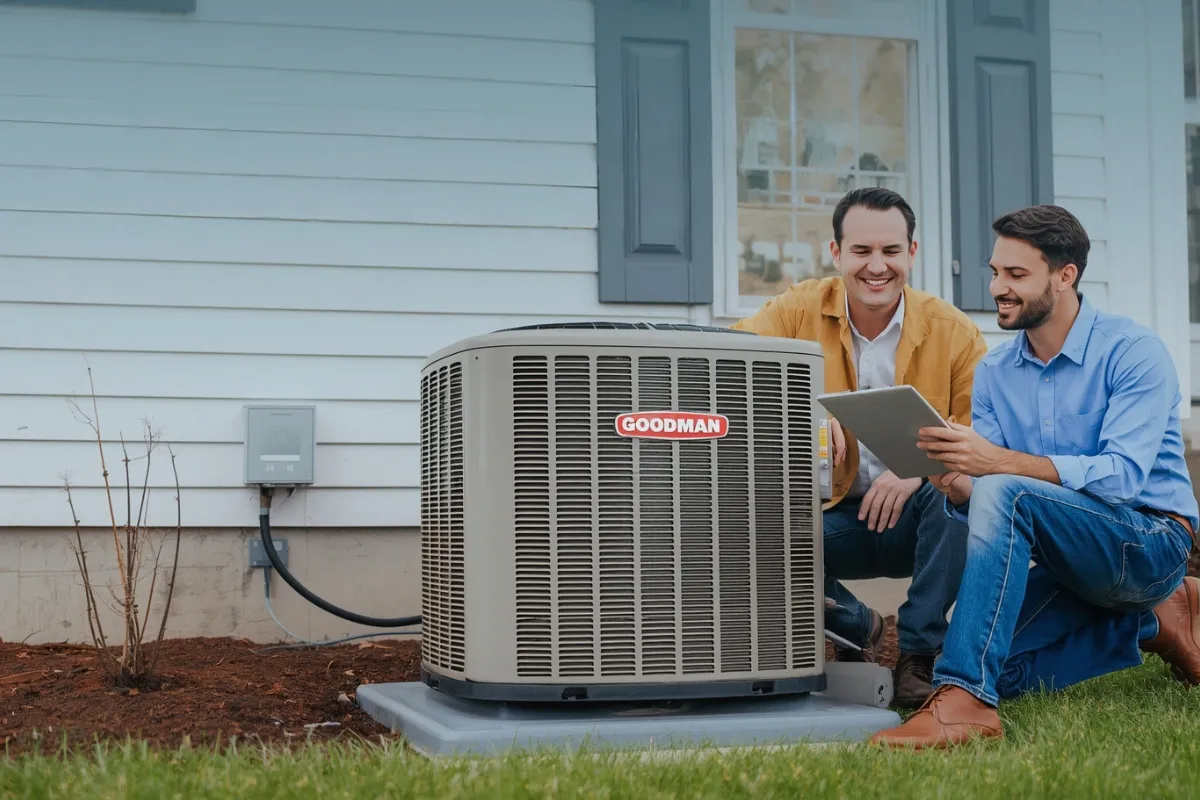
| TL;DR Choose a Goodman AC condenser based on your home’s cooling needs, not just square footage or price. Make sure it’s properly sized, AHRI matched with the right indoor equipment, and installed by a qualified HVAC contractor. The right combination will deliver better comfort, lower energy bills, and reliable performance for years to come. |
Goodman AC Condenser Sizes Explained
One of the biggest mistakes homeowners make is choosing a condenser based only on square footage. While home size is a good starting point, it’s not the only thing that matters. Insulation, ceiling height, window placement, and your local climate all affect the size you actually need.
Below is a general guide to Goodman AC condenser sizes. Your HVAC contractor should always perform a Manual J load calculation before recommending a unit.
1.5 Ton Goodman AC Condenser
A 1.5-ton Goodman AC condenser delivers 18,000 BTUs of cooling and is typically recommended for homes between 600 and 900 square feet. It’s commonly installed in apartments, condos, guest houses, and smaller single-family homes.
If your home has modern insulation, energy-efficient windows, and plenty of shade, this size can keep you comfortable without using more energy than necessary. However, if the home has high ceilings, poor insulation, or receives direct afternoon sun, a larger system may be needed even if the square footage falls within this range.
Most 1.5-ton systems require 600 CFM of airflow and should be paired with a properly matched evaporator coil to achieve the rated SEER2 efficiency.
2 Ton Goodman AC Condenser
A 2-ton Goodman condenser provides 24,000 BTUs of cooling and is generally suitable for homes between 900 and 1,200 square feet. It’s one of the most popular sizes for townhomes, smaller ranch-style homes, and newer energy-efficient houses.
This size offers a good balance between cooling performance and operating costs. When properly sized, it removes humidity effectively while maintaining even indoor temperatures throughout the home.
A 2-ton condenser typically requires 800 CFM of airflow and should always be matched with the correct indoor coil or air handler for the best performance.
2.5 Ton Goodman AC Condenser
A 2.5-ton Goodman condenser produces 30,000 BTUs of cooling and is commonly recommended for homes between 1,200 and 1,500 square feet. It works well for many average-sized homes and is often chosen when a 2-ton system isn’t quite large enough.
This size performs best in homes with average insulation and standard ceiling heights. If your home has large west-facing windows or experiences heavy afternoon sun, your contractor may recommend this size even if your square footage is slightly lower.
A 2.5-ton system moves about 1,000 CFM of air and provides excellent comfort when paired with an AHRI-certified indoor unit.
3 Ton Goodman AC Condenser
The 3-ton Goodman AC condenser is one of the most commonly installed residential sizes. It delivers 36,000 BTUs of cooling and is generally designed for homes between 1,500 and 1,800 square feet.
Many homeowners choose this size because it offers enough cooling for a typical family home without significantly increasing energy costs. When properly matched, it provides steady temperatures, good humidity control, and reliable performance during peak summer months.
A 3-ton system requires approximately 1,200 CFM of airflow. Before selecting this size, your contractor should perform a Manual J load calculation rather than relying on square footage alone.
3.5 Ton Goodman AC Condenser
A 3.5-ton Goodman condenser provides 42,000 BTUs of cooling and is usually recommended for homes between 1,800 and 2,100 square feet. It’s often installed in larger single-story homes or two-story homes with higher cooling demands.
This size is ideal for homes with open floor plans or larger living spaces that require more consistent airflow. Choosing a unit that’s too large can lead to short cycling, while one that’s too small may struggle to keep up during extreme heat.
A 3.5-ton system typically needs 1,400 CFM of airflow and performs best when matched with the correct indoor equipment.
4 Ton Goodman AC Condenser
A 4-ton Goodman AC condenser delivers 48,000 BTUs of cooling and is commonly used in homes between 2,100 and 2,500 square feet. It’s a popular choice for larger homes, especially in warmer climates where air conditioners run for long periods during the summer.
Because larger systems move more air, your home’s ductwork must be properly sized to handle the increased airflow. Installing a 4-ton condenser on undersized ductwork can reduce efficiency and create uneven temperatures.
A 4-ton unit requires approximately 1,600 CFM of airflow and should always be installed as part of a properly matched HVAC system.
5 Ton Goodman AC Condenser
A 5-ton Goodman AC condenser is the largest standard residential size. It produces 60,000 BTUs of cooling and is typically recommended for homes between 2,500 and 3,300 square feet.
This size is commonly installed in large custom homes, multi-story properties, and homes with high cooling loads.
Because of its capacity, proper sizing becomes even more important. An oversized system may cool the house too quickly without removing enough humidity, leaving the home feeling cool but damp.
A 5-ton condenser requires around 2,000 CFM of airflow. It should always be paired with compatible indoor equipment and installed only after a professional load calculation confirms it’s the right choice for your home.
How to Choose the Right Goodman AC Condenser?
Buying a new Goodman AC condenser doesn’t have to be complicated. Follow these steps to make sure you choose a system that keeps your home comfortable and performs efficiently for years.
Step 1: Calculate the Right Size
Start by determining how much cooling your home actually needs. While square footage provides a rough estimate, a Manual J load calculation gives the most accurate results by considering your home’s insulation, windows, ceiling height, and local climate. We use these calculations a lot while doing AC Installation in Dallas. And it always gives us better results.
Step 2: Choose the Right SEER2 Rating
Next, decide how energy efficient you want your system to be. A higher SEER2 rating usually costs more upfront but can reduce your monthly cooling bills. For many homeowners, a 15.2 to 17 SEER2 Goodman condenser offers the best balance between price and long-term savings.
Step 3: Select the Right Goodman Model
Goodman offers several condenser models with different features. If you’re looking for an affordable replacement, a single-stage model may be enough. If you want quieter operation, better humidity control, and improved efficiency, consider a two-stage or variable-speed model.
Step 4: Match It with the Right Indoor Unit
Your outdoor condenser should be paired with a compatible evaporator coil, air handler, or furnace. An AHRI-certified matched system delivers the advertised efficiency, improves performance, and helps protect your manufacturer’s warranty.
Step 5: Consider Installation Requirements
Before purchasing, make sure your existing ductwork, refrigerant lines, electrical circuit, and thermostat are compatible with the new condenser. Some installations may require upgrades to ensure the system operates safely and efficiently.
Step 6: Compare Warranty and Total Cost
Don’t look at equipment price alone. Compare the warranty, installation quality, energy efficiency, and long-term operating costs. A slightly higher upfront investment can often save money on repairs and utility bills over the life of the system.
Why AHRI Certified Matches Matter?
When buying a Goodman AC condenser, don’t focus only on the outdoor unit. It also needs to be matched with the right indoor coil or air handler. That’s where AHRI certification comes in.
The Air-Conditioning, Heating, and Refrigeration Institute (AHRI) tests and certifies complete HVAC systems to verify that they perform as advertised. When a Goodman condenser is paired with an AHRI-certified indoor unit, you know the system has been tested to work together.
Here are a few reasons why an AHRI-certified match is important:
- Delivers the advertised efficiency.
- Protects your warranty.
- Provides better comfort.
- Avoids compatibility issues.
Before purchasing a Goodman AC condenser, ask your HVAC contractor to verify that the complete system is AHRI certified. It’s one of the easiest ways to ensure you’re getting the performance, efficiency, and reliability you’re paying for.
Goodman AC Size Chart
Right Goodman AC condenser starts with understanding how tonnage, BTUs, and home size work together. It works depending on the type of condenser you are using.
The chart below gives a general sizing guideline based on typical residential homes. Keep in mind that these are estimates. Your home’s insulation, ceiling height, windows, local climate, and other factors can all affect the size you actually need.
| Goodman AC Size | Cooling Capacity (BTUs) | Typical Home Size | Recommended Airflow (CFM) |
| 1.5 Ton | 18,000 BTUs | 600–900 sq. ft. | 600 CFM |
| 2 Ton | 24,000 BTUs | 900–1,200 sq. ft. | 800 CFM |
| 2.5 Ton | 30,000 BTUs | 1,200–1,500 sq. ft. | 1,000 CFM |
| 3 Ton | 36,000 BTUs | 1,500–1,800 sq. ft. | 1,200 CFM |
| 3.5 Ton | 42,000 BTUs | 1,800–2,100 sq. ft. | 1,400 CFM |
| 4 Ton | 48,000 BTUs | 2,100–2,500 sq. ft. | 1,600 CFM |
| 5 Ton | 60,000 BTUs | 2,500–3,300 sq. ft. | 2,000 CFM |
How to Size a Goodman AC Condenser Correctly?
Choosing the right Goodman AC condenser isn’t as simple as matching it to your home’s square footage. Two homes with the same floor plan can need completely different AC sizes. That’s why HVAC professionals look at several factors before recommending a system.
Manual J Load Calculation
The best way to size a Goodman AC condenser is with a Manual J load calculation. This industry-standard calculation measures how much cooling your home actually needs by evaluating its construction, layout, and local climate. It helps prevent installing a system that’s either too large or too small.
Your Local Climate
Where you live has a big impact on the size of your AC. Homes in hotter, more humid climates usually require more cooling capacity than homes of the same size in cooler regions. Your local weather should always be considered when selecting a Goodman condenser.
Ceiling Height
Higher ceilings mean more air to cool. A home with 10-foot or vaulted ceilings may need a larger system than a home with standard 8-foot ceilings, even if both have the same square footage.
Insulation
Good insulation keeps cool air inside and hot air outside. Newer, well-insulated homes often need less cooling than older homes with poor insulation or air leaks.
Windows and Sun Exposure
Large windows, especially those facing west or south, allow more heat into your home throughout the day. Homes with lots of direct sunlight usually have a higher cooling load and may require a larger condenser.
Number of Occupants
People, appliances, and electronics all generate heat. A home with a larger family or frequent gatherings can have higher cooling demands than a similar-sized home with fewer occupants.
Avoid Oversizing or Undersizing
An oversized Goodman AC condenser may cool your home too quickly without removing enough humidity, leaving the air feeling damp and uncomfortable. An undersized system will run longer, struggle to reach the thermostat setting, and increase wear on the equipment.
Common Mistakes to Avoid When Buying a Goodman AC Condenser
Buying a new Goodman AC condenser is a big investment, so it’s worth taking a little extra time to make the right decision. Here are some of the most common mistakes homeowners make and how you can avoid them.
Buying Based Only on Tonnage
Many homeowners assume a larger AC will cool their home better. That’s not always true. An oversized condenser can short cycle, leave excess humidity indoors, and wear out faster. On the other hand, an undersized unit may run constantly without keeping your home comfortable. The best choice is a condenser that’s properly sized using a Manual J load calculation.
Reusing an Old or Incompatible Evaporator Coil
Replacing only the outdoor condenser may seem like a way to save money, but keeping an old or incompatible evaporator coil can reduce efficiency and cooling performance. In some cases, it can even shorten the life of your new Goodman condenser. Always ask your HVAC contractor if your existing indoor coil is compatible.
Hiring the Cheapest Installer
Even the best Goodman AC condenser can perform poorly if it’s installed incorrectly. Proper refrigerant charging, airflow adjustments, electrical connections, and system testing all affect how well your new AC operates. Choosing an experienced, licensed HVAC contractor is just as important as choosing the right equipment.
Final Thoughts
Take the time to compare models, understand your home’s cooling needs, and verify that your condenser is AHRI matched with the proper indoor equipment. A little research before you buy can help you avoid higher energy bills, comfort issues, and costly repairs later on.
When in doubt, have an experienced HVAC professional perform a load calculation and recommend a system that’s designed specifically for your home. It’s the best way to get the comfort, efficiency, and reliability you’re paying for.
Frequently Asked Questions
Do I need to replace the evaporator coil too?
Not always, but it’s often recommended. If your current coil is old, incompatible, or designed for a different refrigerant, replacing it with a matched Goodman coil will improve performance and help the system achieve its rated SEER2 efficiency.
What is an AHRI-matched system?
An AHRI-matched system is a combination of an outdoor condenser and indoor equipment that has been tested and certified to work together. Choosing an AHRI-certified match helps ensure better efficiency, reliable performance, and proper warranty coverage.
Which Goodman condenser has the highest SEER2 rating?
Goodman’s variable-speed models, such as the GSXV9, offer some of the highest SEER2 ratings in the lineup. They provide better energy efficiency, quieter operation, and improved humidity control than standard single-stage models.
Is Goodman better than Carrier or Trane?
Goodman is known for offering dependable performance at a more affordable price. Carrier and Trane typically offer more premium features, but they also cost more. The best choice depends on your budget, efficiency goals, and the quality of the installation.
How long does a Goodman AC condenser last?
With professional installation and regular maintenance, a Goodman AC condenser typically lasts 15 to 20 years. Keeping the condenser clean and scheduling annual tune-ups can help extend its lifespan.
What refrigerant do new Goodman condensers use?
Most new Goodman condensers are being introduced with low-GWP A2L refrigerants, such as R-32 or R-454B, depending on the model. These refrigerants meet newer environmental standards and replace older R-410A systems.
Can a Goodman condenser work with another brand of air handler?
Sometimes, but compatibility isn’t guaranteed. For the best efficiency and performance, Goodman recommends using an AHRI-certified matched system with compatible indoor equipment.
Does a higher SEER2 rating always save money?
A higher SEER2 rating uses less electricity, but it also costs more upfront. If you live in a hot climate or use your AC frequently, the energy savings can make the investment worthwhile. For many homeowners, a mid-range SEER2 system offers the best overall value.